Everything you Need
To Verify and Control
Nebraska Identity
Documents
Our printed I.D. Checking Guides and online versions are used by
DMVs, government agencies at all levels, and businesses.
Check Nebraska Drivers Licenses & IDs

Nebraska ID Verification and Fake ID Prevention
Spotting a fake Nebraska ID quickly is just as important as confirming a valid one. Fake identification is a persistent challenge for businesses, law enforcement, and security teams across Nebraska. Bars, liquor stores, casinos, retailers, financial institutions, and secure facilities rely on accurate identification checks to deter fraud, underage alcohol sales, and criminal misrepresentation.
Read More
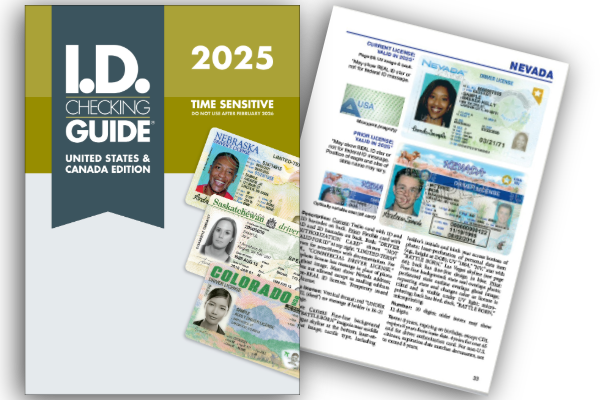
The I.D. Checking Guide (U.S. & Canada) helps professionals verify identification documents from every U.S. state, U.S. territory, and all Canadian provinces and territories. The guide provides reference information for confirming card orientation, expiration format, identification number structure, physical characteristics, and security features, enabling employees and officers to verify the ID corresponds to the person presenting it.
For organizations that perform frequent ID checks, consistent verification procedures are an important part of reducing risk and supporting compliance with Nebraska laws.
What Does the I.D. Checking Guide Help You Verify?
Nebraska businesses and agencies often review hundreds of identification documents each week. Employees must make fast decisions while still following company procedures and applicable laws. The I.D. Checking Guide helps users verify:
- License orientation
- License term
- Identification number format
- Physical characteristics
- Security features
- Microprinting
- Issuing authority information
- Overall physical match between the ID and the presenter
The guide is used as a practical reference tool during age verification, traffic stops, account verification, retail transactions, and access control procedures.
Why Is ID Verification Important?
Nebraska businesses face several risks tied to fraudulent identification documents. A fake ID may be used to:
- Purchase alcohol illegally
- Commit financial fraud
- Cash fraudulent checks
- Gain unauthorized access to secure locations
- Misrepresent identity during commercial or financial transactions
- Bypass age restrictions
- Support organized retail theft
Employees who understand how to compare identification documents against known formatting and security details are better prepared to identify inconsistencies before completing a transaction.
Verification procedures are especially important in industries where employees interact with unfamiliar customers throughout the day.
What Types of Fake IDs Are Common?
Fake identification documents can vary widely in quality and appearance. Some may contain obvious mistakes, while others attempt to imitate legitimate identification documents more closely. Common warning signs may include:
- Incorrect card orientation
- Mismatched fonts or spacing
- Expiration dates that do not follow the correct validity period
- Inconsistent physical characteristics
- Missing security features
- Damaged surfaces around printed information
- Altered birth dates
- Poor-quality photo placement
- Missing or incorrect microprinting
Employees should also pay attention to the overall physical condition of the card and whether the identification information appears consistent throughout the document.
Which Industries Commonly Use ID Verification Guides?
Many industries throughout Nebraska depend on accurate ID verification procedures to help reduce fraud and maintain compliance.
Law Enforcement
During patrol stops, investigations, and field interviews, officers must quickly confirm identification details while maintaining situational awareness. Reliable reference information helps officers compare IDs against known formatting and security features.
Financial Services
Banks, credit unions, and check cashing businesses rely on valid identification documents during account verification and financial transactions. Employees may review IDs when opening accounts, cashing checks, or verifying customer identity.
Alcohol Sales and Hospitality
Nebraska businesses involved in alcohol sales must verify age before completing transactions. Restaurants, bars, convenience stores, liquor retailers, and event venues often use ID reference materials to support employee training and reduce compliance risks.
Retail Operations
Retailers may review identification documents during returns, age-restricted purchases, or fraud investigations. Consistent verification procedures can help reduce fraudulent transactions and identity misrepresentation.
Facility Access Control
Security teams at utilities, data centers, warehouses, healthcare facilities, and government buildings may rely on photo identification to restrict access to authorized personnel and visitors.
Alcohol Sales & Service Guidelines for Nebraska
- Minimum age to consume: 21 - Minimum age to serve: 19 - Minimum age to bartend: 19
A person under 21 may purchase alcoholic beverages as part of a law enforcement action.
Penalties for serving or selling to a minor: In Nebraska, selling or serving alcohol to a minor is a criminal charge that can result in severe penalties. The penalties depend on the circumstances and the type of offense:
- Unintentionally or knowingly providing alcohol to a minor
This is a Class I misdemeanor, which can result in up to a year in jail and a $1,000 fine.
- Misrepresenting age
This is a Class III misdemeanor, which can result in up to three months in jail.
- Providing alcohol to a minor that results in serious bodily injury or death
This is a Class IIIA felony, which can result in a minimum of 30 days in prison, up to three years, and a $10,000 fine.
In addition to fines and jail time, those convicted of supplying alcohol to minors may also be required to perform community service or other services and may be placed on probation. Businesses with liquor licenses may also face administrative actions, such as license suspension or revocation, and additional fines.



How Can Nebraska Businesses Improve Fake ID Verification Procedures?
Strong verification practices usually begin with consistency. Businesses should establish procedures that explain:
- What employees must verify
- When identification checks are required
- How to inspect security features
- When to request secondary review
- How to document suspicious incidents
Employees should understand that identification checks involve more than simply reviewing the birth date. Verification should include:
- Card format
- Physical characteristics
- Expiration validity
- Security features
- Overall physical match
Using a standardized reference tool helps employees follow the same process across shifts and locations.
Why Do Businesses Use the I.D. Checking Guide (U.S. & Canada)?
For more than 50 years, the I.D. Checking Guide has helped professionals verify IDs and support fraud prevention efforts. Organizations use the guide to:
- Strengthen employee training
- Improve verification consistency
- Support age-restricted sales compliance
- Reduce fraud risks
- Review security features
- Compare IDs from multiple jurisdictions
- Assist with operational procedures
The guide supports verification efforts involving every U.S. state, U.S. territory, and all Canadian provinces and territories.
Nebraska Fake ID FAQs
What should employees check on a Nebraska ID?
Employees should review the expiration date, physical characteristics, card orientation, identification number format, photograph, and security features.
Can businesses in Nebraska refuse suspicious identification documents?
Yes. Businesses may refuse transactions when an ID appears altered, inconsistent, expired, or otherwise suspicious.
Who uses the I.D. Checking Guide in Nebraska?
Law enforcement agencies, bars, retailers, financial institutions, casinos, security teams, and hospitality businesses commonly use ID verification reference materials.
Why is ID verification important for alcohol sales?
Nebraska businesses that sell alcohol must verify age before completing sales. Consistent ID checks help reduce underage sales risks and support compliance with applicable laws.
What types of fraud can fake IDs support?
Fraudulent identification documents may be used during underage alcohol purchases, financial fraud, retail fraud, identity misrepresentation, and unauthorized access attempts.
Protect your employees, customers, and business operations with trusted ID verification reference materials. The I.D. Checking Guide (U.S. & Canada) helps professionals across Nebraska verify identification documents with greater consistency and confidence.
How to Spot a Fake Nebraska ID
For law enforcement officers, bank tellers, car rental agents, human resources professionals and others who must verify ID in a professional capacity, the recent surge in fake IDs is challenging. The liability and losses that result from accepting a fake ID are large. The I.D. Checking Guide assists in the ID verification process by showing what an actual, valid ID looks like at full-size, and highlights the details of the licenses, making it much easier to spot the fraud. Before approving an expensive car rental, opening a new bank account or hiring a new employee, make sure the driver's license or ID card has the correct numbering, UV, microprint, ghost images, expiration, and other details that counterfeiters often miss.

Markets Served

Financial Services

Alcohol Control

Government

Law Enforcement
What the I.D. Checking Guide Includes:
- A full page or more for each U.S. state and Canadian province, showing driver's licenses and ID cards.
- Security image information for ghost images, laser perforation, microprint, UV and other validation details.
- Explanation of what the proper alphanumeric sequencing of a Nebraska ID or Driver's License should be (how many letters, numbers, etc.).
- U.S. Federal documents including immigration, military ID, Visas and passport cards.
- "How to check driver's licenses" techniques for training.